Ring Customer Experience
Subscription Lifecycle Email Redesign
THE CHALLENGE
After 10 years of helping neighbors protect what matters most, Ring discovered a critical gap: while customers readily adopted our devices, subscription conversion and feature activation had plateaued.
The problem was multi-layered:
Text-heavy emails with simple design failed to capture attention
Complex feature education overwhelmed rather than empowered
Buried calls-to-action made conversion paths unclear
Generic messaging didn't account for customer context (first device vs. fifth device)
Timing wasn't optimized for engagement
The stakes:
Stagnant net revenue retention
Untapped customer lifetime value potential
Customers missing out on features that could meaningfully impact their security
Lost revenue that could fuel innovation
THE PROCESS
Phase 1: Journey Mapping & Segmentation
Working cross-functionally with Product, Data Analytics, and Engineering teams, I:
Mapped the complete subscription trial journey from device setup through conversion
Identified friction points where customers dropped off
Defined segmentation logic based on customer data
Created personalized content flows for each customer segment
Phase 2: Strategic Email Architecture
I redesigned the email program structure to:
Prioritize high-value features based on device type and usage
Layer information progressively (awareness → education → activation)
Create clear, actionable CTAs that felt helpful, not pushy
Ensure consistent messaging across all touchpoints
Rather than explaining every feature, we focused on the 3-5 features that data showed had the highest impact on subscription retention for each segment.
Phase 3: Content Creation & Collaboration
Partnering with graphic design, I transformed the email experience:
Before:
Text-heavy, transactional layouts
Generic feature descriptions
Weak value propositions
Hidden CTAs
After:
Visual-first design with clear hierarchy
Contextualized feature education ("Here's what Ring can do for your home")
Benefit-driven copy focused on peace of mind and security outcomes
Prominent, action-oriented CTAs
Voice transformation example:
✖️ Before: "Your Ring Protect subscription includes Advanced Motion Detection. This feature allows you to customize motion zones."
✔ After: "Want to stop getting alerts every time a car passes by? Advanced Motion Detection lets you focus on what matters — your front door, not the street."
Cross-functional collaboration:
Product: Aligned on feature prioritization and trial experience
Legal: Ensured compliance while maintaining conversational tone
Engineering: Implemented segmentation logic and send timing
Marketing: Maintained brand consistency across channels
Phase 4: Testing & Optimization
We didn't launch and hope — we tested and learned:
A/B tested subject lines, CTAs, and content hierarchy
Monitored engagement metrics (open rates, click-through, conversion)
Gathered qualitative feedback through customer support insights
Continuously iterated based on performance data
Emails with customer success stories outperformed feature-only emails by 24% in engagement.
THE PREPARATION
We needed to shift from generic broadcast messaging to contextual, trust-building conversations that met customers where they were in their journey.
Through data analysis, we discovered:
Usage patterns revealed segmentation opportunities
Customers with first device vs. multiple devices had vastly different needs
Feature adoption varied significantly based on device type
Existing subscribers vs. new customers required different messaging approaches
Engagement data showed timing gaps
Existing sends weren't aligned with high-engagement windows
Subscription trial period had clear momentum points we weren't leveraging
Post-conversion engagement dropped when feature education stopped
User feedback indicated trust gaps
Transactional tone felt impersonal and corporate
Feature education felt like "selling" rather than "helping"
Value proposition wasn't clear at critical decision points
From there, we built a content strategy founded on strategic pillars that focused on creating meaning for the customer:
1. Segmentation Over Saturation
Instead of sending everyone everything, we designed targeted journeys based on:
Device ownership stage (first device vs. established user)
Feature usage patterns during trial
Subscription status (new vs. existing customer)
2. Data-Driven Timing
Analyzed engagement patterns across existing lifecycle to identify:
Peak engagement days for maximum impact
Critical momentum points in trial period
Optimal spacing to avoid fatigue
3. Voice & Tone Shift
From: Corporate transactional messaging
To: Trusted neighbor sharing insider recommendations
This shift aligned with Ring's core mission: neighbors helping neighbors.
4. Design Principles
UX/UI-first approach: Scannable, visual hierarchy, clear CTAs
ADA accessibility: Inclusive design for all users
Advertising mindset: Make every email feel like a gift, not a sales pitch
THE RESULT
Redesigned subscription lifecycle program featuring:
Email Architecture
8 segmented customer journeys based on device ownership, usage, and subscription status
Optimized send cadence targeting high-engagement days during trial period
Progressive feature education layered across touchpoints
Content Framework
Visual-first templates with scannable layouts and clear CTAs
Contextual messaging that speaks to specific customer needs
Conversational tone that builds trust and transparency
Benefit-driven copy focused on outcomes, not features
Cross-Touchpoint Consistency
Ensured cohesive narrative across:
Email campaigns
In-app messaging
Help center content
Chat support scripts
The Impact
Business Results
+33% year-over-year increase in subscription revenue
+12% year-over-year lift in subscription retention
24% higher engagement on storytelling-driven emails vs. feature-only
User Experience Wins
✔ Reduced drop-off at critical subscription decision points
✔ Increased feature adoption during and post-trial
✔ Higher customer satisfaction reflected in support ticket reduction
✔ Stronger brand trust through transparent, helpful communication
Team Impact
Established reusable content frameworks that scaled to other lifecycle programs
Created segmentation playbook adopted across CX organization
Demonstrated ROI of content design investment to leadership

Ring Alarm
UX Improvements
The Challenge
During emergencies, every second and every word matters. Ring Alarm's in-app experience needed to deliver critical security information — including legal disclosures and emergency protocols — without overwhelming customers. The challenge: make highly technical, legally-required information feel human, clear, and confidence-building. Emergency information must be immediate yet comprehensive, legal language must be accurate yet understandable, and the tone must be authoritative without fear-mongering.
The Process
Partnering with UX Designers, Product Managers, and Engineering, I designed content that works in both day-to-day moments and high-stress emergency contexts. Through multi-round ideation and testing, I established principles that balanced being authoritative yet friendly, clear without oversimplifying, and actionable without alarming. I created information architecture that surfaced critical info during setup, enabled easy reference later through progressive disclosure, and maintained consistent patterns across features. The result transformed technical alerts like "ALERT: Intrusion detected. Law enforcement dispatch protocol initiated" into empowering guidance: "Your alarm is active. We're notifying emergency services now.”
The Result
The redesigned Ring Alarm in-app experience reduced setup friction, increased user confidence through transparent communication, and improved emergency response with calm, actionable messaging. By making legal opt-ins understandable and establishing a consistent, confidence-building voice, Ring differentiated itself through human-centered security messaging while reducing customer support bandwidth and building user trust through transparency about monitoring, privacy, and emergency protocols.
Ring Help Center
CMS Migration + UX Improvements
The Challenge
Ring's help center had become what customers feared most: a difficult-to-navigate maze of technical jargon only decipherable by the people who wrote it. Thousands of articles needed updating before migrating to a new CMS under a tight deadline, serving users ranging from tech-savvy early adopters to first-time smart home users. Ring saw this as an opportunity to completely reimagine the customer support experience by transforming legally necessary but inaccessible security information into clear, helpful guidance.
The Process
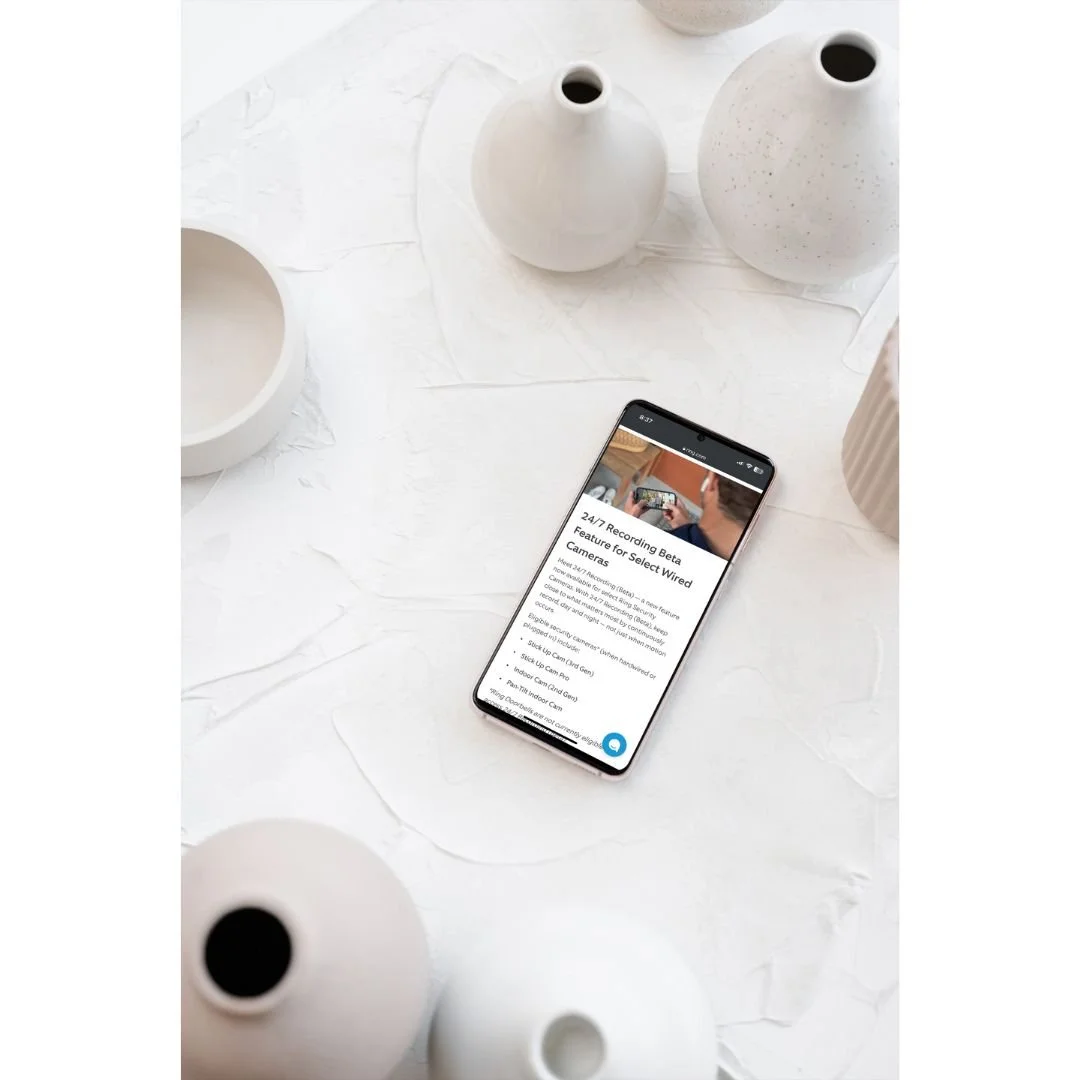
As Technical/UX Writer specializing in Ring Alarm, I audited all Ring Alarm articles for technical accuracy, language accessibility, and user journey alignment. I transformed intimidating technical instructions into clear, step-by-step guidance that respects customer intelligence while removing barriers. Working cross-functionally with CxE, Product, UX Design, and Engineering teams, I reorganized the help center from Ring's internal product structure to customer intent — reducing clicks-to-answer from 4-5 to 2-3. I applied UX principles including dynamic formatting, visual hierarchy, and progressive disclosure to create scannable, timeless article structures.
The Result
The redesigned help center delivered faster problem resolution through clearer instructions and better information architecture, making home security accessible to all experience levels. Thousands of articles were updated on deadline, creating a scalable content framework that reduced support ticket volume as customers found self-service answers. The mobile-optimized, customer-centric organization improved findability and established a foundation for future help center evolution.